Seven Strategies for a Psychologically Safe Workplace
(As adapted from the Thirteen Psychosocial Risk Factors, the Guarding Minds @ Work Program)
- Management Style
A psychologically safe management style, according to Shain, is one which is a balanced, expressive/directive style: communicative, supportive, participative, cooperative while being, when needed, decisive and directive.[1]
- Monitoring & Protection
Co-workers and supervisors are supportive of employees’ psychological and mental health concerns and respond appropriately as needed. There are support frameworks in place and, more importantly, employees are aware of the organizational support.
- Communication & Engagement
Workplace psychological safety is demonstrated when workers feel able to put themselves on the line, ask questions, seek feedback, report mistakes and problems, or propose a new idea without fearing negative consequences to themselves, their job or their career.[2]
Employee engagement can be physical, emotional and/or cognitive. Physical engagement is based on the amount of exertion an employee puts into his or her job. Physically engaged employees view work as a source of energy. Emotionally engaged employees have a positive job outlook and are passionate about their work. Cognitively engaged employees devote more attention to their work and are absorbed in their job. Whatever the source, engaged employees feel connected to their work because they can relate to, and are committed to the overall success and mission of their company. [3]
- Organizational Culture
The degree to which a work culture is characterized by trust, honesty, and fairness. In general, psychologically safe organizational culture has been described as “a pattern of basic assumptions invented, discovered, or developed by a given group.” These assumptions are a mix of values, beliefs, meanings and expectations that group members hold in common and that they use as behavioural and problem-solving cues. The critical task is to determine which of these assumptions enhance the psychological safety and health of the workplace.
Workplace culture is arguably the category that has the biggest impact on the promotion of employee mental health. Factors related to workplace culture are: Communication, social support, beliefs, values and norms, management practices, attitudes and perceptions, job satisfaction, job control and decision making, leadership style, work-life balance and human resource systems.[4]
- Workload Management & Work-life Balance
Tasks and responsibilities can be accomplished successfully within the time available. This is the risk factor that many working Canadians describe as being the biggest workplace stressor (i.e., having too much to do and not enough time to do it). Research has demonstrated that it is not just the amount of work that makes a difference but also the extent to which employees have the resources (time, equipment, support) to do the work well.[5]
There is recognition of the need for balance between the demands of work, family, and personal life. This factor reflects the fact that everyone has multiple roles: as employees, parents, partners, etc. This complexity is enriching and allows fulfillment of individual strengths and responsibilities, but conflicting responsibilities can lead to role conflict or overload.[6]
- Job Environment
There is a good match between employees’ interpersonal and emotional competencies, their job skills and the position they hold. This means that employees not only possess the technical skills and knowledge for a particular position, but they also have the psychological skills and emotional intelligence to do the job. Emotional intelligence includes self-awareness, impulse control, zest, persistence, self-motivation, empathy and social deftness. Of note is the fact that a subjective job fit has been found to be more important than an objective job fit, meaning it is more important for employees to feel they fit their job, rather than being assessed and matched to the job. A psychologically safe job environment also allows growth and development. Employees receive encouragement and support in the development of their interpersonal, emotional and job skills.
- Awards, Recognition & Team Building
There is appropriate acknowledgement and appreciation of employees’ efforts in a fair and timely manner. This includes appropriate and regular financial compensation as well as employee or team celebrations, recognition of years served, and/or milestones reached.
Policy Framework and Legal Duty to Care
Senior leaders must establish, implement and monitor a Psychologically Safe Workplace Policy and should include procedures for assessing and addressing risks to mental health at work, referring to relevant programs and services. Ideally, they should do this before the standards become mandatory.[7] Use our Sample Policy as a guideline or contact us to assist in it’s creation.
There are three (3) components to the Legal “Duty to Care”:
- Keep demands within reasonable bounds
- Enable basic “voice” (make it safe to speak up)
- Monitor and respond to signs of conflict/distress
This duty to care strictly applies only to the following:[8]
- Those with a pre-existing mental illness or disorder before they came to work for their present employer.
- Those who had an episode of mental disability that has caused them to be off work.
- Those who are at risk of mental injury/disability because of psycho-toxic conditions of work.
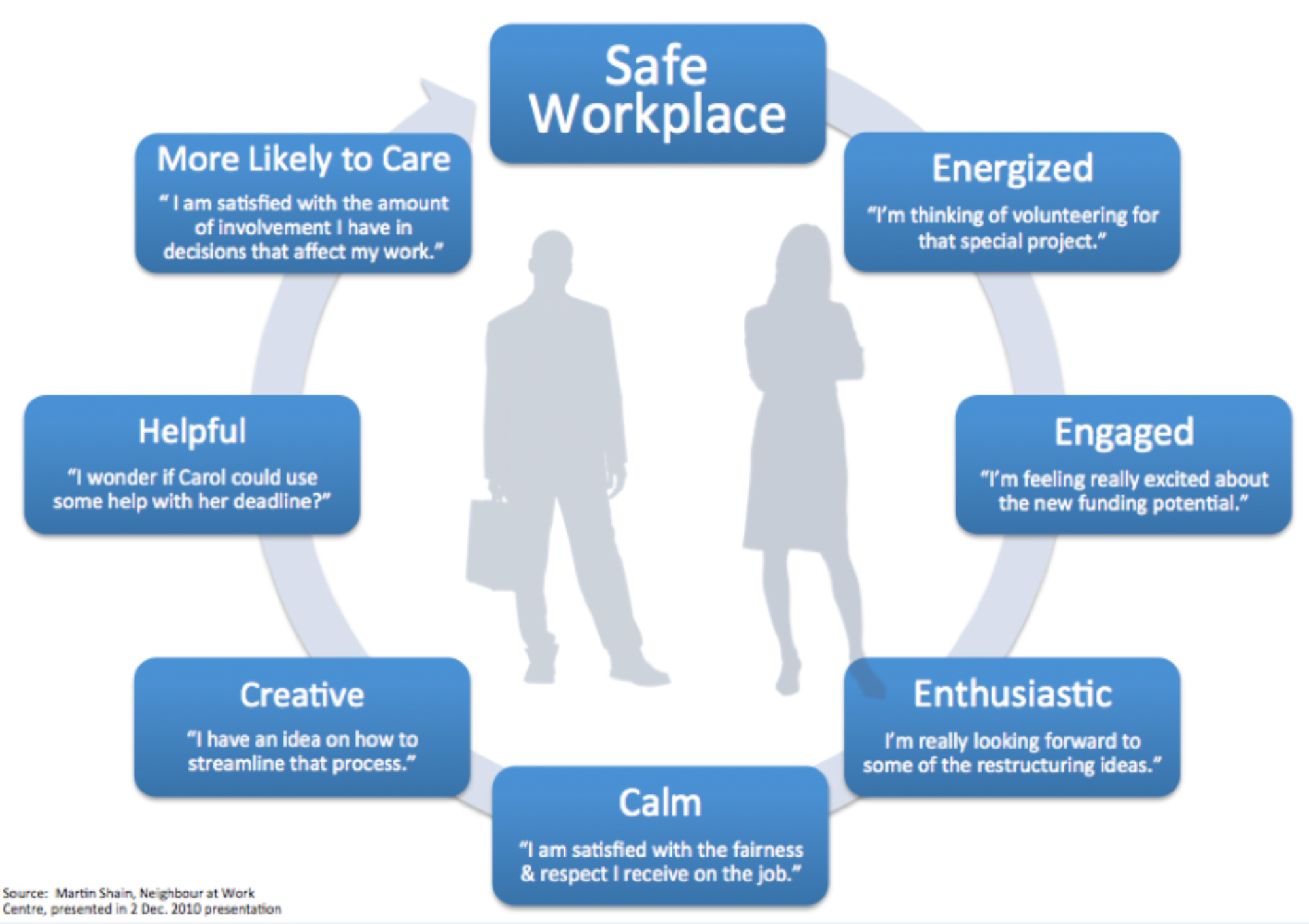
The “Feel” of a Psychologically Safe Workplace
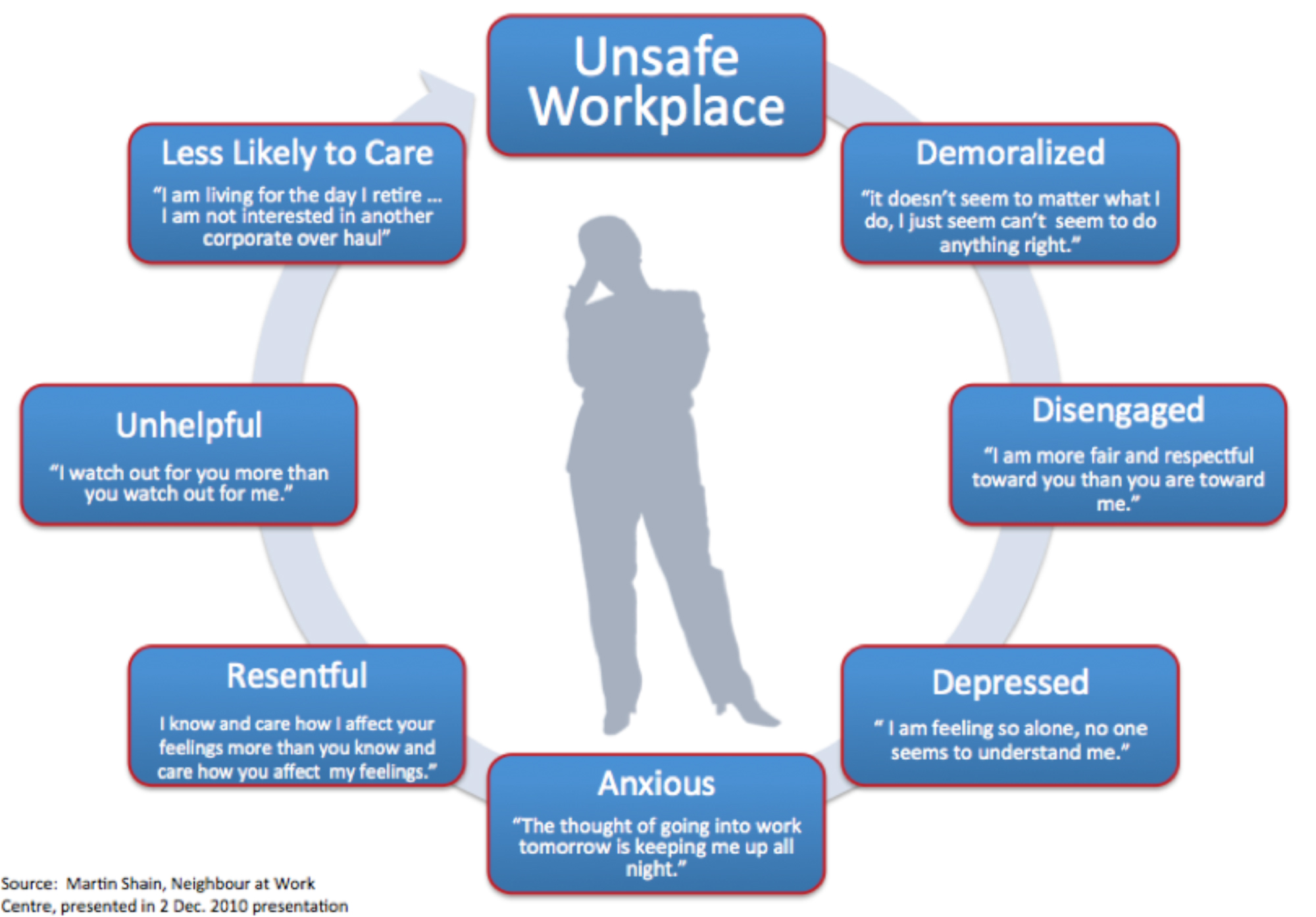
The “Feel” of a Psychologically Unsafe Workplace
[1]The Psychologically Safe Workplace: New legal requirements and how to address them. Presentation by Martin Shain, S.J.D. Minister’s Action on Wellness Forum, 2 Dec. 2010
[2]Guarding minds @ work: Psychological Risk Factors. Web. 20 Oct 2011.
[3]Guarding minds @ work: Psychological Risk Factors. Web. 20 Oct 2011.
[4]Minding the Workplace. Alberta Health Services. Web. 9 Nov. 11.
[5]Guarding minds @ work: Psychological Risk Factors. Web. 20 Oct 11.
[6]Guarding minds @ work: Psychological Risk Factors. Web. 20 Oct 11.
[7]The Psychologically Safe Workplace: New legal requirements and how to address them. Presentation by Martin Shain, S.J.D. Minister’s Action on Wellness Forum, 2 Dec. 2010
[8]The Psychologically Safe Workplace: New legal requirements and how to address them. Presentation by Martin Shain, S.J.D. Minister’s Action on Wellness Forum, 2 Dec. 2010